KSMC

Global Pulse

Global Pulse

China Issues New Draft M&A Loan Rules to Ease Terms and Widen Scope

China’s National Financial Regulatory Administration has released draft regulations to expand and ease bank lending for mergers and acquisitions (M&A), marking the first time bank loans can support minority equity deals. The new rules split M&A into two categories: “control acquisitions,” where buyers take majority stakes, and “equity acquisitions,” for minority stakes of at least 20%. Under the draft, banks can lend up to 70% of the deal value for control acquisitions with loan terms extended to 10 years from the previous 7 years. For equity acquisitions, loans can cover up to 60% with a maximum 7-year term. Banks must meet asset thresholds—CNY 50 billion (~$7 billion) for control acquisition loans and CNY 100 billion (~$14 billion) for equity acquisition loans. With over 3,500 M&A deals completed in China in the first half of 2025, totaling nearly CNY 800 billion (~$111 billion), the expanded loan scope aims to further support corporate restructuring and investment diversity.

Global Pulse

Perplexity AI Makes Stunning $34.5B Bid for Google Chrome Browser

AI search company Perplexity has submitted an unsolicited $34.5 billion offer to purchase Google’s Chrome browser, a bold move that comes as Google faces anti-trust pressure following last year’s landmark ruling. The Numbers Why Now?: The Department of Justice has proposed forcing Google to sell Chrome as an anti-trust remedy, though Google plans to appeal. Perplexity’s bid positions the AI startup to capitalize on regulatory pressure against Big Tech. The Bigger Picture: Perplexity launched its own browser “Comet” in July, while OpenAI is reportedly developing one too. The three-year-old startup has also bid for TikTok and been courted by Meta and Apple. While Perplexity’s bid is considered a long shot given Google’s resistance, it signals intensifying competition for web browser dominance in the AI era.

Global Pulse

The Rise of the Everyday Millionaire: The EMILLI Phenomenon

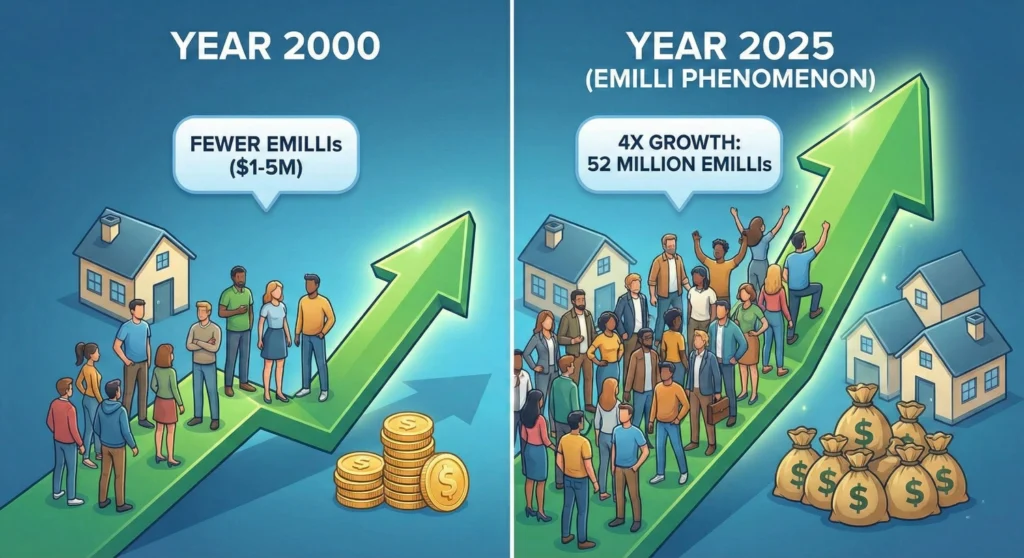
A quiet but powerful shift is underway in global wealth. According to the UBS Global Wealth Report 2025, the number of “Everyday Millionaires” (EMILLIs)—those with $1–5 million in assets—has more than quadrupled since 2000, reaching 52 million people worldwide. Further, this segment now controls wealth exceeding $107 trillion—over 2.5 times their aggregate wealth (in real terms) at the turn of the millennium. This nearly matches the $119 trillion owned by individuals with assets above $5 million. What’s Driving the Surge? The main factors are strong real estate appreciation and rising financial markets, especially in the U.S. and Europe. Currency movements and inheritance also play a part, with millions moving into millionaire status almost invisibly. Implications for the Future The continued expansion of the EMILLI segment signals a structural change in global wealth distribution. The “millionaire next door” is no longer an anomaly; they are fast becoming the standard in many markets. As asset values, especially property, continue to climb and financial literacy grows, the EMILLI class is set to play an even more prominent role in the global economy. For deeper insights into this and related topics, you can access the full 2025 Global Wealth Report here.

Global Pulse

When Machines Match Humans: Amazon’s Robot Army Hits 1 Million

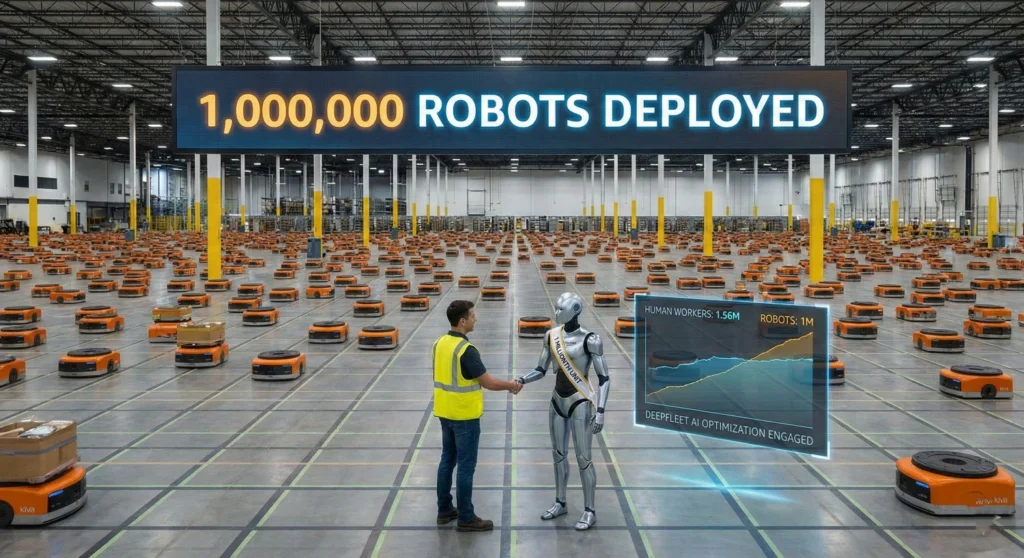
Amazon has reached a striking milestone—deploying its one millionth warehouse robot after 13 years of automation! The milestone robot was recently delivered to a fulfillment center in Japan. With approximately 1.56 million total employees worldwide, the company is swiftly approaching a point where robots may equal human workers in its facilities, with 75% of global deliveries already getting robotic assistance. The e-commerce giant also launched DeepFleet, a new AI model that optimizes robot coordination and promises 10% faster warehouse operations. Amazon’s automation journey began with its 2012 acquisition of Kiva Systems and shows no signs of slowing. 👉 Read more: Amazon deploys its 1 millionth robot, releases generative AI model

Global Pulse

Insurance M&A Activity Hits the Brakes in North America

The North American insurance brokerage M&A market is cooling off, with deal activity declining 8% in the first half of 2025. OPTIS Partners reported 319 transactions across the US and Canada, down from 345 in the same period last year. Market Enters “New Normal”: Industry experts believe the market has reached a sustainable pace after years of frenzied deal-making. Steve Germundson of OPTIS Partners expects annual deal volume to stabilize at 750-800 transactions going forward. Despite the overall slowdown, Q2 2025 showed signs of recovery with 168 deals—an 11% increase from Q2 2024. Private Equity Still Dominates: Private equity-backed firms continue driving consolidation, accounting for 73% of all deals through 32 active buyers. The top 11 buyers captured 59% of total deal volume, with most backed by private equity capital. BroadStreet Partners led activity with 39 deals, followed by Hub International (27) and Inszone Insurance Services (18). P&C Focus Continues: Property and casualty agencies dominated transactions, representing 209 of the 319 deals (65%). Mixed P&C and benefits agencies accounted for 27 deals (8%), while standalone benefits agencies comprised 42 transactions (13%). Most transactions involved US-based sellers (305), while Canadian brokerages accounted for 14 deals. The data suggests the insurance M&A market is transitioning from explosive growth to measured consolidation, with sustained demand for P&C distribution assets driving strategic acquisitions focused on geographic expansion and scale.

Global Pulse

Buffett’s Last Hurrah? Berkshire’s $9.7B Bet on OxyChem

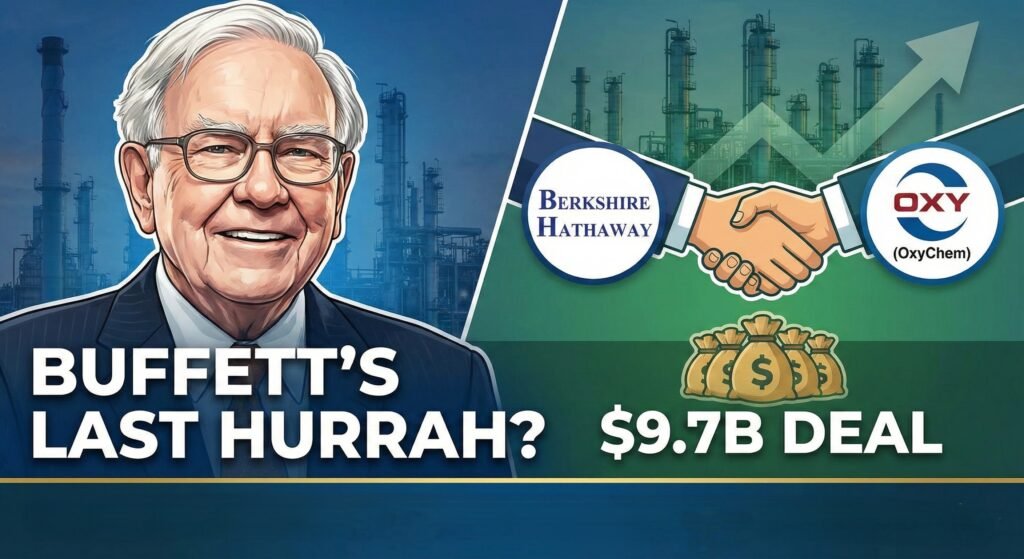
Warren Buffett is going out with a bang—or at least, that’s what everyone’s assuming! Berkshire Hathaway is acquiring Occidental Petroleum’s chemicals division, OxyChem, in a $9.7 billion all-cash deal. This marks Berkshire’s largest deal since the $12 billion Alleghany purchase in 2022. The deal is a clear win-win: Berkshire gains a steady, cash-generating business at attractive terms, while Occidental uses the proceeds to cut debt by $6.5 billion, strengthening its balance sheet in a challenging energy environment. Buffett’s long-standing ties with Occidental add depth to this move—Berkshire owns around 28-30% of the oil company and previously helped finance Occidental’s Anadarko takeover in 2019. The acquisition solidifies Berkshire’s foothold in the energy and chemicals sector while allowing Occidental to focus on debt reduction and shareholder returns. As Buffett prepares to hand over the reins to Greg Abel later this year, this deal embodies his signature value investing approach: predictable, durable businesses over flashier, high-growth bets. Whether or not it’s his final deal, Buffett’s OxyChem acquisition underscores a legacy grounded in patience, pragmatism, and long-term vision.

Global Pulse

The AI Acquisition Paradox: Why Buyers Are Enthusiastic But Hesitant?

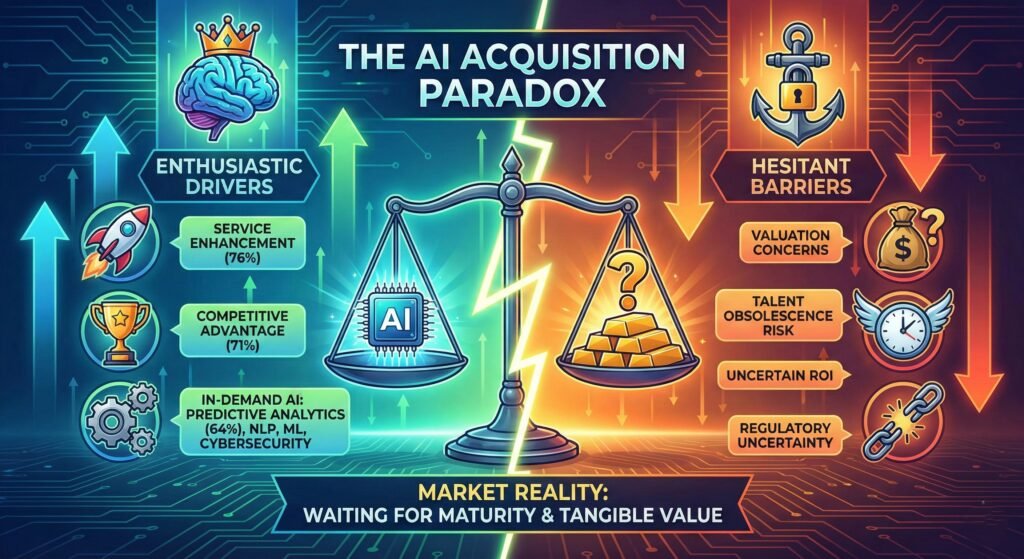
Artificial intelligence has become the most talked-about technology in boardrooms worldwide, but despite overwhelming interest, more than one-in-three buyers haven’t made a single AI-related acquisition. This paradox reveals a market caught between opportunity and uncertainty, where the promise of transformation clashes with practical concerns about value, talent, and obsolescence. What’s driving AI Acquisitions? According to a 2025 Global Buyers Report by Equiteq, Companies aren’t buying AI for cost savings—they’re chasing differentiation. The report shows 76% of corporate acquirers cite service enhancement as their primary driver, while 71% focus on competitive advantage. Private Equity firms mirror these priorities, with 70% seeking differentiation for portfolio companies. This signals a fundamental shift: AI isn’t viewed as an operational tool but as essential to staying relevant. The AI Capabilities In Demand Why The Hesitation? Where Companies Stand Today? Many companies are still establishing concrete use cases that create genuine competitive advantages. Success increasingly hinges on data infrastructure—AI models are only as effective as the data feeding them. Beyond valuation concerns, three operational challenges are slowing deal activity: (i) risk aversion around unproven technologies, (ii) lack of internal expertise to properly evaluate AI companies, and (iii) regulatory uncertainty as governments worldwide grapple with AI oversight. These areas require greater certainty before buyers commit capital to AI acquisitions. What’s Next For AI M&A The market is maturing from hype-driven speculation toward disciplined deal-making. Buyers are asking harder questions about real business problems, talent sustainability, and value justification. While current activity remains measured, acquisition momentum will build as AI technologies mature, use cases crystallize, and tangible outcomes multiply. The buyers sitting on the sidelines today aren’t disinterested—they’re waiting for clearer signals about which capabilities will deliver lasting value in an industry where patience may prove the smartest strategy.


Global Pulse

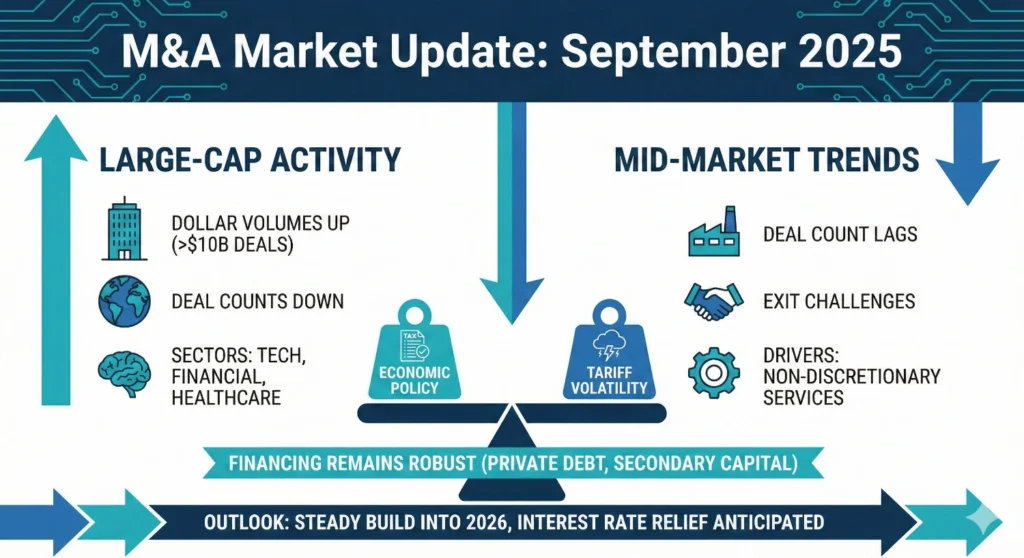
M&A Market Update: September 2025

The M&A landscape in 2025 continues to show divergent trends between large-cap and mid-market activity. While dollar volumes have increased materially thanks to headline-grabbing transactions worth $10+ billion, deal counts remain down 10-20%, and the mid-market has not seen the same boost. Economic policy is stabilizing, with reduced uncertainty and supportive tax and deregulation tailwinds, though tariff volatility persists. Financing remains robust as private debt and secondary capital strategies help firms meet their liquidity needs, especially in the mid-market where traditional exits have proven difficult. Non-discretionary services continue to drive mid-market deals, while technology, financial services, and healthcare headline large-cap activity. Recent notable transactions include Advent’s acquisition of LayerZero Power Systems (industrial technology), TopBuild’s $810M purchase of Progressive Roofing (commercial services), and Vomela Companies’ acquisition of PFL Tech (marketing automation software). Exit activity is expected to build slowly but steadily alongside continued M&A momentum into 2026—should interest rate relief materialize as expected.

Scroll to Top