In mid-market M&A across the US and Canada, choosing asset versus share purchase can materially shift seller’s proceeds on exit. Most practitioners get this in theory. Execution is where it breaks down.
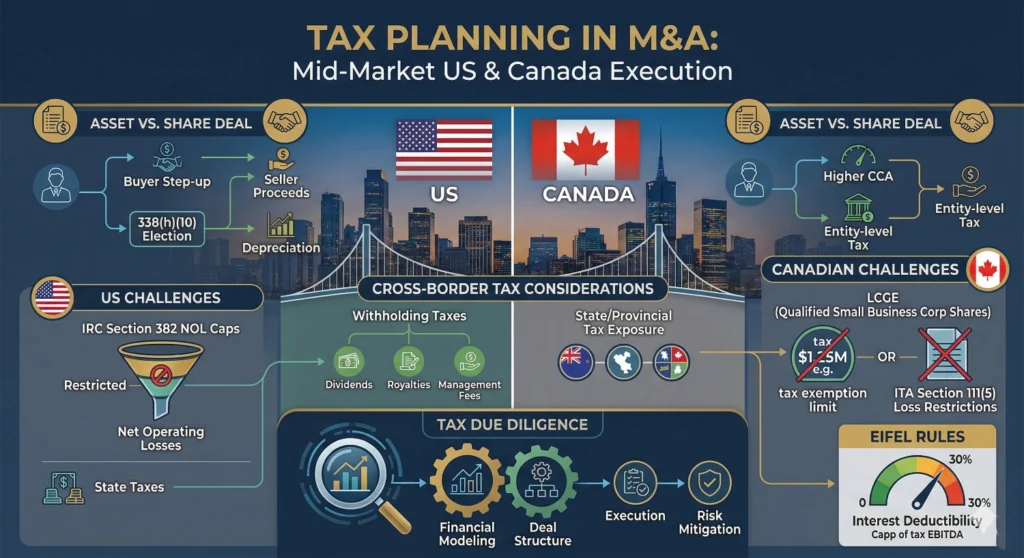
The Challenge: In the US, on asset deals, buyers get a step-up in asset basis for better depreciation. A 338(h)(10) election offers similar benefits in stock deals but only for certain S-corps or subsidiaries, and it needs seller consent, sometimes resulting in a price bump for sellers.
In Canada, asset deals provide higher capital cost allowance (CCA) on stepped-up depreciable assets. Sellers resist, on both sides, as an asset deal triggers tax at the entity level, often followed by a second layer of personal tax on distributions. Canadian sellers also lose the Lifetime Capital Gains Exemption (LCGE), now up to $1.25M per eligible shareholder for Qualified Small Business Corporation (QSBC) shares under post-2024 rules, available only on qualifying share sales.
Why This Matters?
- Loss limits: US IRC Section 382 caps net operating losses (NOLs) post-ownership change. Section 111(5) of Canada’s IT Act restricts non-capital losses after a change in control
- State/provincial taxes: Companies attract varying tax exposures due to multi-state or cross-provincial operations, which can create forecast errors if blended rates are used in the initial deal financial models
- EIFEL (Excessive Interest and Financing Expenses Limitation) rules: Leveraged Canadian Buyouts (LBO) deals cap deductible interest at 30% of tax EBITDA for years starting Jan 1, 2024 onward (40% transition earlier)
- Cross-border withholding: For US-Canada transactions, management fees, royalties, and dividends carry different withholding rates under the Canada-US Tax Convention
- Tax Due diligence: Cross-check tax returns against internal financials to confirm loss attributes, QSBC eligibility, and normalization adjustments. Gaps here disqualify LCGE or NOLs and unwind pricing
What Good Execution Looks Like:
- Settle deal structure before the LOI
- In Canadian deals, verify QSBC eligibility at the outset
- Confirm loss attribute usability early: Model the ownership change triggers before assigning value to NOLs or NCLs
- Run EIFEL sensitivity before debt terms are set on Canadian acquisitions
- Map withholding taxes on post-close flows upfront
- Keep tax counsel in the room through closing, not just at the start. Policy changes, late diligence findings, and SPA negotiations all create moments where the original tax structure needs to be pressure-tested again
Real life Example: A PE fund acquires a US-based industrial services business at $18M equity value. The Target carries $9M in NOL carryforwards, which the buyer models as a meaningful tax shield. Later it was discovered that two years ago the Target raised funds through a bridge equity round at depressed valuation which triggered an ownership change under IRC Section 382. Annual NOL usage is capped at equity value immediately before the change × long-term tax-exempt rate (~$200K/year). The $9M takes 40+ years to absorb, which means the expected benefit is practically gone. A tax due diligence would have potentially revealed this in a day.
Share Your Experience: Have you encountered NOL or NCL restrictions, or a QSBC eligibility gap, affecting deal structure or pricing? How did you bridge it?