KSMC

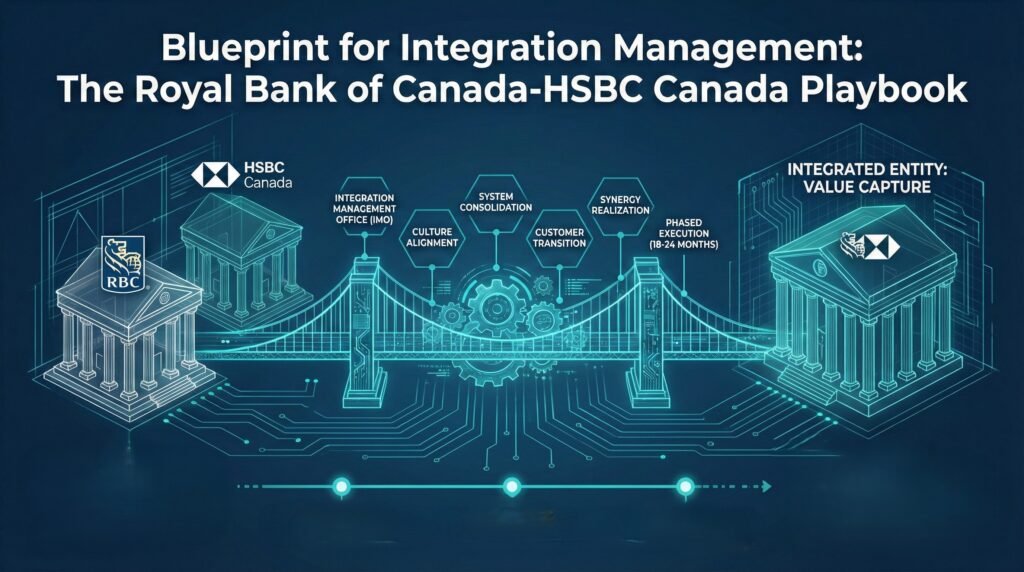
Blueprint for Integration Management: The Royal Bank of Canada-HSBC Canada Playbook

What This Means: Integration management involves the systematic combination of two organizations’ operations, cultures, systems, and strategies to achieve acquisition objectives. This includes establishing an Integration Management Office (IMO), designing organizational structures, aligning cultures, consolidating systems, and optimizing performance toward synergy realization.

The Challenge: While acquirers dedicate significant resources to due diligence, insufficient planning for integration often creates a gap between deal rationale and value capture—turning promising transactions into stalled transformations.

Why It Matters: Studies consistently show that 50–70% of acquisitions fail to meet their objectives, largely due to weak integration design and insufficient post-deal governance. Effective integration management is therefore the critical determinant of acquisition success.

Real Deal Example: On March 28, 2024, Royal Bank of Canada (RBC) completed its acquisition of HSBC Bank Canada (HSBC) in an all-cash $13.5 billion deal, marking one of Canada’s largest bank acquisitions in history.

  • The integration is being managed through dedicated teams focused on seamless customer transition, system consolidation, and employee integration involving approximately 4,500 HSBC employees and over 800,000 customers.
  • RBC assembled a comprehensive legal and operational team covering M&A, retail and commercial banking, compliance, and technology to oversee the complex transition.
  • The integration is being executed in phases over 18-24 months, with branch conversions (in April 2024) and system/technical migrations (in November 2024) carefully sequenced to minimize customer disruption.
  • The transaction received regulatory approval with conditions designed to maintain competitive dynamics in the Canadian banking market.
  • The acquisition strengthens RBC’s domestic market presence while delivering anticipated strategic and operational synergies.

The deal positioned RBC to expand its client base, enrich its product suite, and accelerate growth in competitive banking sectors, demonstrating robust integration management and value capture in a complex, large-scale financial services transaction.

Connect & Share: Connect with us to share insights from your own deals – learning from real-world execution accelerates collective mastery of M&A integration management.
🌍 Global Pulse

The AI Acquisition Paradox: Why Buyers Are Enthusiastic But Hesitant?

Artificial intelligence has become the most talked-about technology in boardrooms worldwide, but despite overwhelming interest, more than one-in-three buyers haven’t made a single AI-related acquisition. This paradox reveals a market caught between opportunity and uncertainty, where the promise of transformation clashes with practical concerns about value, talent, and obsolescence.

What’s driving AI Acquisitions?

According to a 2025 Global Buyers Report by Equiteq, Companies aren’t buying AI for cost savings—they’re chasing differentiation. The report shows 76% of corporate acquirers cite service enhancement as their primary driver, while 71% focus on competitive advantage. Private Equity firms mirror these priorities, with 70% seeking differentiation for portfolio companies. This signals a fundamental shift: AI isn’t viewed as an operational tool but as essential to staying relevant.

The AI Capabilities In Demand

  • Predictive analytics leads at 64% buyer interest for its measurable business outcomes.
  • Natural language processing attracts 44%, driven by customer service applications.
  • Machine learning garners 33% interest for personalization and optimization.
  • AI-enabled cybersecurity has surged among corporate buyers, reflecting growing security imperatives.

Why The Hesitation?

  • Valuation: The AI market moves so quickly that determining which platforms will dominate the future becomes a high-stakes guessing game. Thus, buyers site valuation as their biggest concern.
  • Talent: For financial buyers, talent retention is paramount. Today’s specialized skills may not remain valuable over typical 5-7 year investment horizons.
  • ROI: Strategic buyers share a concern around obsolescence—the risk that acquired capabilities will be superseded by newer approaches within months, creating uncertainty around the returns from AI acquisitions.

Where Companies Stand Today?

Many companies are still establishing concrete use cases that create genuine competitive advantages. Success increasingly hinges on data infrastructure—AI models are only as effective as the data feeding them.

Beyond valuation concerns, three operational challenges are slowing deal activity: (i) risk aversion around unproven technologies, (ii) lack of internal expertise to properly evaluate AI companies, and (iii) regulatory uncertainty as governments worldwide grapple with AI oversight. These areas require greater certainty before buyers commit capital to AI acquisitions.

What’s Next For AI M&A

The market is maturing from hype-driven speculation toward disciplined deal-making. Buyers are asking harder questions about real business problems, talent sustainability, and value justification. While current activity remains measured, acquisition momentum will build as AI technologies mature, use cases crystallize, and tangible outcomes multiply.

The buyers sitting on the sidelines today aren’t disinterested—they’re waiting for clearer signals about which capabilities will deliver lasting value in an industry where patience may prove the smartest strategy.

🤖 AI Tools Spotlight

Perplexity’s Comet, The AI Browser, Is Now FREE

Perplexity’s Comet browser, once an exclusive beta for Max subscribers, became free for all users recently in October, 2025. More than another AI add-on, Comet reimagines how people interact with the web—turning browsing into intelligent action.

What The Tool Does?: Beyond simple queries, Comet lets users request practical tasks—comparing products, organizing research, or drafting summaries—using natural language prompts. Its integrated tools such as Discover (personalized recommendations) and Spaces (project organization) streamline workflows for professionals managing large information volumes.

Key Features: Unlike traditional browsers that simply display information, Comet’s built-in sidecar assistant actively engages with what you view. It answers questions, summarizes content, and navigates web pages—all in real time and without switching tabs. Testers report that it works across platforms like social media, YouTube, and Google Docs. Comet also comes preloaded with Perplexity’s AI search engine, which delivers direct, cited answers instead of lists of links. The result removes the repetitive search‑click‑read cycle of standard browsing.

Why It Matters?: Comet is already available on Windows, macOS, and Linux systems, with mobile versions on the way. Its performance shows what’s possible when search and action blend into a single experience. Whether the world is ready for an autonomous browser—and whether it should be—is the debate just beginning.

Scroll to Top