KSMC

Author name: admin

Global Pulse

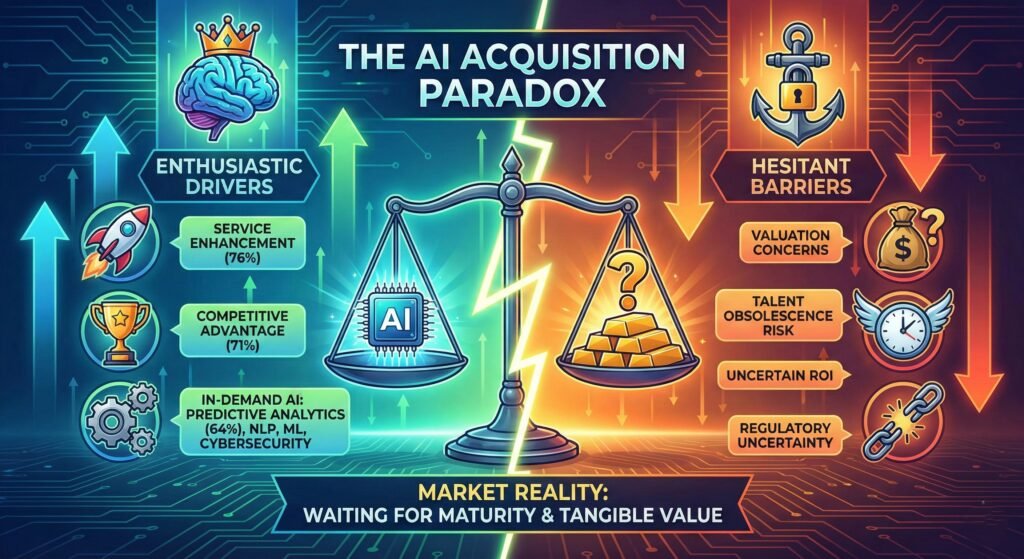
The AI Acquisition Paradox: Why Buyers Are Enthusiastic But Hesitant?

Artificial intelligence has become the most talked-about technology in boardrooms worldwide, but despite overwhelming interest, more than one-in-three buyers haven’t made a single AI-related acquisition. This paradox reveals a market caught between opportunity and uncertainty, where the promise of transformation clashes with practical concerns about value, talent, and obsolescence. What’s driving AI Acquisitions? According to a 2025 Global Buyers Report by Equiteq, Companies aren’t buying AI for cost savings—they’re chasing differentiation. The report shows 76% of corporate acquirers cite service enhancement as their primary driver, while 71% focus on competitive advantage. Private Equity firms mirror these priorities, with 70% seeking differentiation for portfolio companies. This signals a fundamental shift: AI isn’t viewed as an operational tool but as essential to staying relevant. The AI Capabilities In Demand Why The Hesitation? Where Companies Stand Today? Many companies are still establishing concrete use cases that create genuine competitive advantages. Success increasingly hinges on data infrastructure—AI models are only as effective as the data feeding them. Beyond valuation concerns, three operational challenges are slowing deal activity: (i) risk aversion around unproven technologies, (ii) lack of internal expertise to properly evaluate AI companies, and (iii) regulatory uncertainty as governments worldwide grapple with AI oversight. These areas require greater certainty before buyers commit capital to AI acquisitions. What’s Next For AI M&A The market is maturing from hype-driven speculation toward disciplined deal-making. Buyers are asking harder questions about real business problems, talent sustainability, and value justification. While current activity remains measured, acquisition momentum will build as AI technologies mature, use cases crystallize, and tangible outcomes multiply. The buyers sitting on the sidelines today aren’t disinterested—they’re waiting for clearer signals about which capabilities will deliver lasting value in an industry where patience may prove the smartest strategy.
Deal Strategy

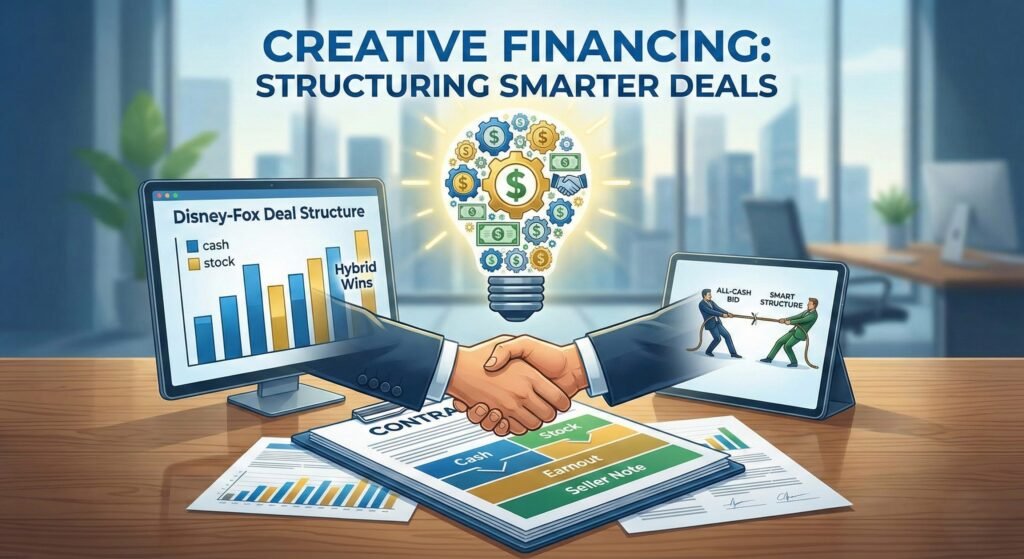
Creative Financing: Structuring Smarter Deals

What This Means: Creative financing involves structuring deal funding through non-traditional methods when conventional debt or equity financing is insufficient, unavailable, or strategically undesirable. This can include leveraged buyouts, mezzanine financing, contingent consideration, or complex debt arrangements. The Challenge: In hotly contested acquisitions, pure cash offers may seem attractive to sellers, but buyers must balance competitive positioning with capital efficiency and shareholder value preservation. Why It Matters: Strategic financing structures can optimize deal outcomes across all transaction types—whether addressing competitive auctions, bridging valuation gaps, preserving capital flexibility, or aligning stakeholder interests—but require sophisticated execution to avoid overpaying or overleveraging. Real Deal Example: Disney’s $71.3 billion acquisition of 21st Century Fox assets in 2019. Mid-Market Application: While this example showcases a mega-deal between public companies, the same creative financing principles apply powerfully to middle-market and private company transactions. Consider a $10M acquisition where the buyer uses seller financing for 20% of the purchase price, earnout provisions tied to EBITDA growth, and management rollover equity—this hybrid approach can help bridge valuation gaps, preserve buyer cash, and align all parties around success metrics. The scale may differ, but the strategic logic of optimizing deal structure through creative financing remains equally valuable. Deep Dive Available: For strategies on structuring competitive bids that win on value rather than just cash, including hybrid structures, let’s schedule a discussion.

AI Tools Spotlight

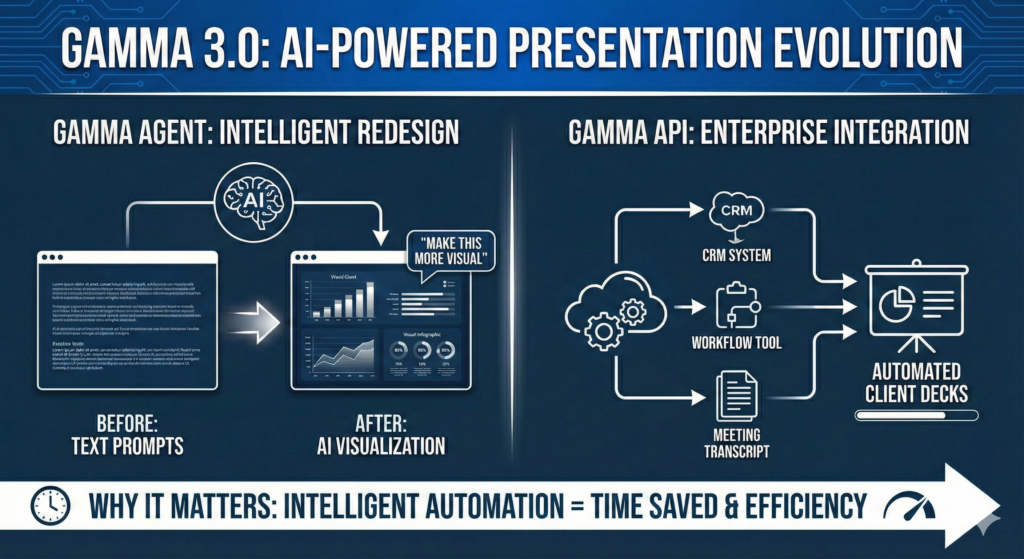
Gamma Launches Version 3.0 With New AI Capabilities

What The Tool Does?: Gamma is an AI presentation platform that creates professional slide decks from text prompts. Version 3.0 transforms it into an intelligent design assistant that can automatically redesign entire presentations and integrate with business workflows. Key Features: Why It Matters?: This latest update shifts Gamma from manual slide editing to intelligent automation. With 50 million users, it addresses the core problem: presentations take too much time to create.

Global Pulse

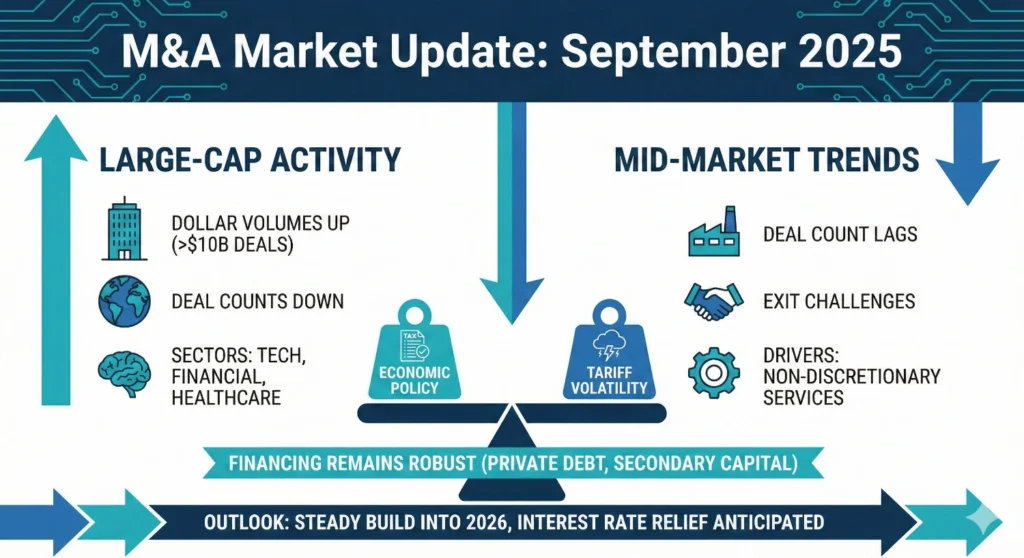
M&A Market Update: September 2025

The M&A landscape in 2025 continues to show divergent trends between large-cap and mid-market activity. While dollar volumes have increased materially thanks to headline-grabbing transactions worth $10+ billion, deal counts remain down 10-20%, and the mid-market has not seen the same boost. Economic policy is stabilizing, with reduced uncertainty and supportive tax and deregulation tailwinds, though tariff volatility persists. Financing remains robust as private debt and secondary capital strategies help firms meet their liquidity needs, especially in the mid-market where traditional exits have proven difficult. Non-discretionary services continue to drive mid-market deals, while technology, financial services, and healthcare headline large-cap activity. Recent notable transactions include Advent’s acquisition of LayerZero Power Systems (industrial technology), TopBuild’s $810M purchase of Progressive Roofing (commercial services), and Vomela Companies’ acquisition of PFL Tech (marketing automation software). Exit activity is expected to build slowly but steadily alongside continued M&A momentum into 2026—should interest rate relief materialize as expected.

Scroll to Top